
Elena Lange · 8 September 2026
Decoding Crawl Efficiency Metrics for Authority-Building in Narrow Interest Areas
Search engines allocate limited resources to scan and index web pages, and crawl efficiency metrics measure how effectively those resources get used on sites focused on narrow interest areas. Data from September 2026 shows that sites in specialized topics often face tighter crawl budgets because search algorithms prioritize broader domains unless specific signals indicate high relevance and authority within the niche.
Understanding Core Crawl Efficiency Metrics
Crawl rate, crawl demand, and server response times form the foundation of these metrics, and researchers track them through tools that log how many pages a bot requests per day while noting any errors or delays that reduce overall efficiency. Narrow interest sites benefit when their server handles requests quickly, because prolonged load times can trigger reduced crawl frequency according to Google's documentation on crawling and indexing.
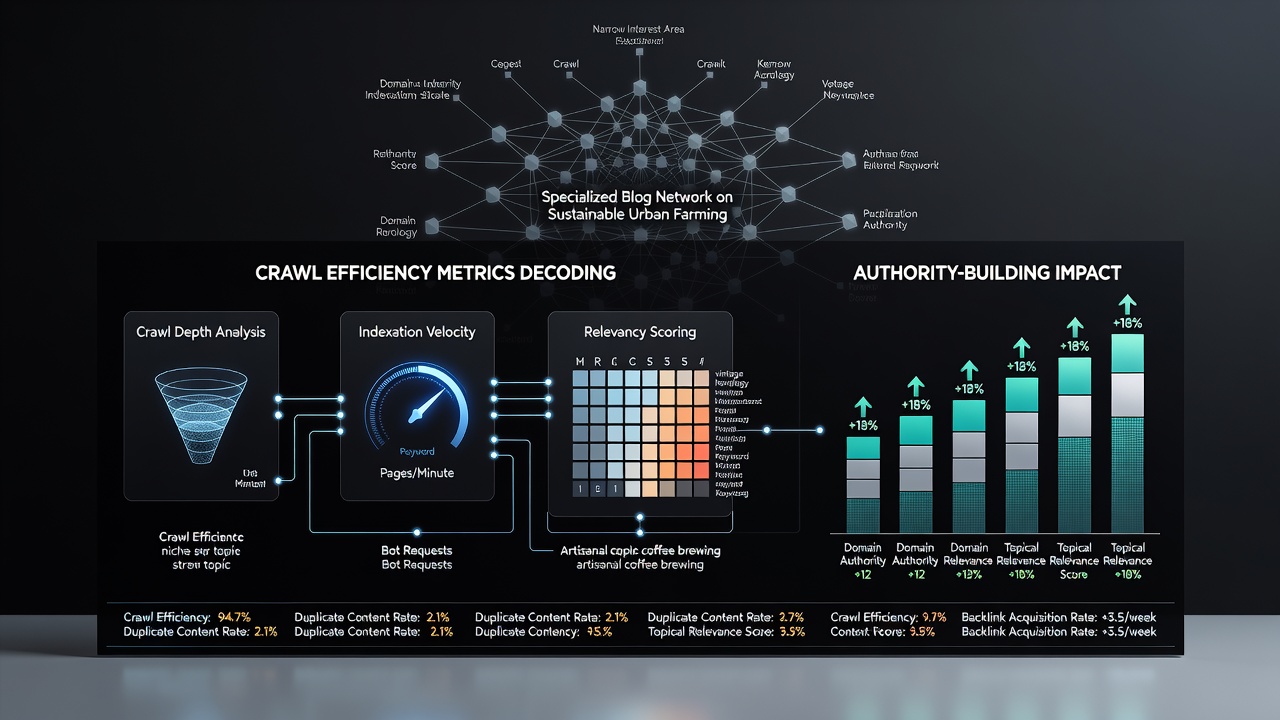
Indexation ratios also play a key role, since they reveal what percentage of submitted or discovered pages actually appear in search results, and studies indicate that niche sites with strong topical clusters achieve higher ratios when internal linking guides crawlers toward key authority pages. Observers note that metrics like duplicate content flags and URL parameter handling directly affect how much of a site's narrow focus gets recognized over time.
Linking Metrics to Authority Signals in Specialized Topics
Authority in narrow interest areas develops through consistent content depth and external references, yet crawl efficiency determines whether those assets receive proper evaluation by search systems. When a site demonstrates efficient crawling through stable server performance and logical site architecture, algorithms allocate more resources to deeper pages that contain the detailed information users in that niche seek.
But here's the thing: sites that ignore crawl budget waste often see slower authority growth because key articles remain undiscovered for extended periods, and data from industry reports released in September 2026 confirms that optimized crawl paths correlate with faster ranking improvements in competitive micro-niches. Researchers have observed that combining high-quality backlinks with clean crawl structures creates a feedback loop where search engines visit more frequently and index new content faster.
Practical Approaches to Measuring and Improving Efficiency
Webmasters use server logs and analytics platforms to calculate crawl stats, including the ratio of successful requests to total attempts, and they adjust robots.txt directives or XML sitemaps when metrics reveal under-crawled sections. Those who've studied this process find that segmenting content into clear topical silos helps crawlers allocate budget more effectively across narrow interest pages without diluting focus across unrelated material.
What's interesting is how response time thresholds influence long-term outcomes, since pages that load under two seconds tend to receive more frequent visits while slower sections get deprioritized. A link to official guidance on crawling processes outlines these thresholds in detail, and similar patterns appear in analyses from the Australian Web Archive that examined niche site performance across multiple regions.
Regional Data Patterns and Recent Findings
Reports compiled in September 2026 highlight variations across different geographic markets, where European sites in narrow technical fields showed stronger indexation when they maintained consistent crawl efficiency compared with less optimized competitors. Canadian research institutions tracking digital content have noted similar trends, emphasizing that server location and CDN usage can reduce latency enough to improve overall metric scores for authority-building efforts.
People often discover that monitoring changes after site updates reveals whether efficiency gains translate into better visibility, and one study revealed that sites implementing structured data alongside crawl optimizations saw measurable lifts in how quickly new niche content entered search indexes. External references from authoritative sources further reinforce these patterns when they point to well-structured pages that crawlers can reach without friction.
Conclusion
Crawl efficiency metrics provide measurable indicators that directly influence how search systems evaluate and rank content in narrow interest areas, and organizations that track these figures systematically position their sites for stronger authority development over time. Data released through September 2026 continues to underscore the connection between efficient crawling and sustained visibility in specialized topics, giving site operators concrete benchmarks to apply when refining their approach.