Elena Lange · 6 October 2026
Tracking Moss Spore Dispersal Mechanisms Across Fragmented Urban Green Spaces
Urban environments present distinct challenges for bryophyte populations because green spaces often exist as isolated patches separated by buildings, roads, and other infrastructure that interrupt natural dispersal pathways, and researchers have documented how these barriers shape spore movement patterns in cities worldwide. Studies tracking spore release show that wind remains the primary vector for many moss species, yet its effectiveness drops sharply when fragments measure less than a few hectares and sit more than 500 meters apart, while secondary mechanisms such as attachment to vehicles, clothing, or animal fur gain relative importance in these settings.
Primary Dispersal Vectors in City Settings
Wind dispersal operates through ballistic release from sporophytes followed by airborne transport, and data collected from anemometers placed at various heights in parks indicate that spores of species like Funaria hygrometrica can travel several hundred meters under moderate gusts, although turbulence created by tall structures frequently redirects them downward before they clear the fragment edge. Water flow along gutters and drainage channels provides another route, particularly during heavy rainfall events when spores wash into temporary streams that connect otherwise separate green areas, and observations in European cities confirm that such hydrodynamic transport can move viable spores across distances exceeding one kilometer when topography favors runoff concentration.
Animal-mediated dispersal occurs when spores adhere to fur, feathers, or feet, and monitoring programs using sticky traps on urban wildlife corridors have recorded higher deposition rates near paths frequented by birds and small mammals. In October 2026 researchers from multiple institutions released preliminary results showing that pigeons and starlings carry spores of at least twelve common urban mosses between rooftop gardens and ground-level parks, with viability rates remaining above 60 percent after passage through the digestive tract of some species.
Impact of Fragmentation on Spore Survival
Fragmentation reduces the probability that a spore lands in suitable microhabitat, and measurements of substrate pH, moisture retention, and light exposure across dozens of city parks reveal that only a narrow subset of patches supports germination for any given moss species. When suitable sites lie farther apart, the number of spores required to colonize a new fragment increases exponentially, according to models developed from long-term monitoring plots in North American metropolitan areas. Soil compaction and pollution further narrow viable establishment zones, so even spores that reach a target patch may fail to produce gametophytes if surface conditions have been altered by heavy foot traffic or chemical runoff.
Methods Used to Monitor Spore Movement
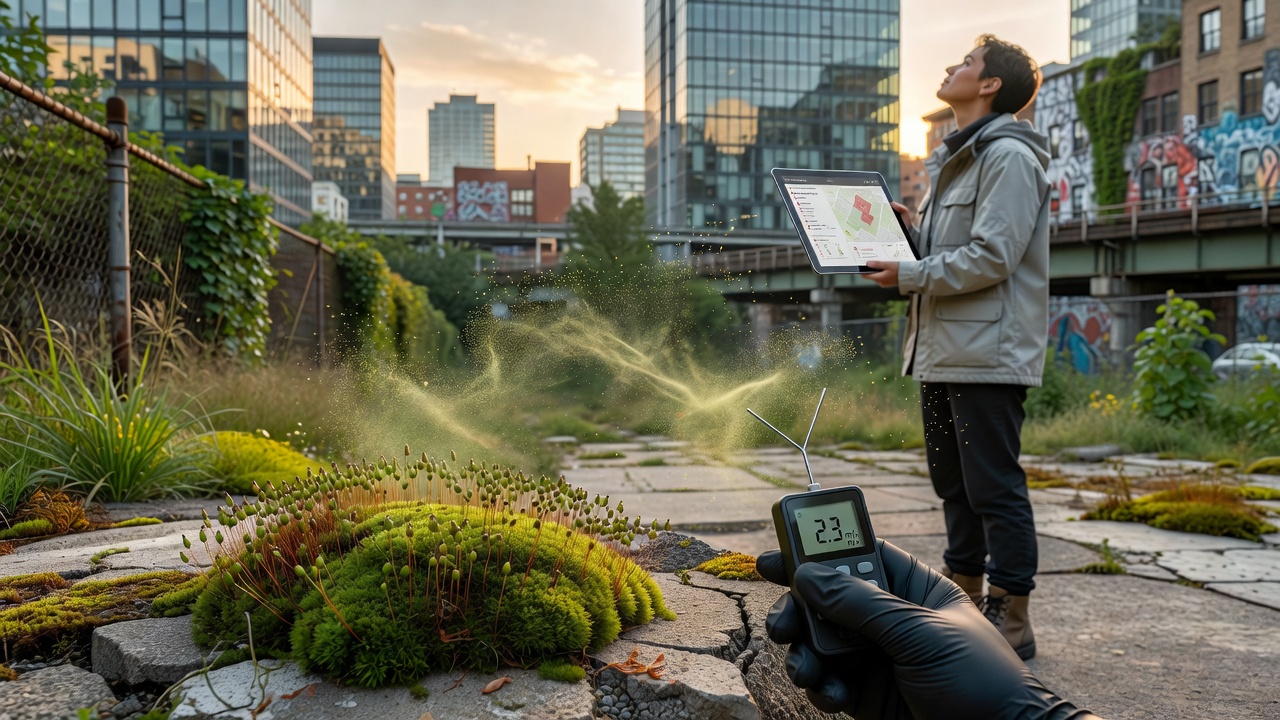
Researchers deploy a combination of passive spore traps, genetic markers, and drone-based air sampling to quantify dispersal distances and directions, and these approaches allow differentiation between local recruitment and long-distance arrivals. Genetic analysis of established colonies compared with potential source populations has shown that many urban moss stands contain individuals whose nearest genetic relatives occur several kilometers away, indicating successful crossing of built barriers. Drone flights equipped with adhesive samplers flown at multiple altitudes above green-space networks provide three-dimensional maps of spore clouds during peak release periods, and results indicate that spores concentrate in the lee of buildings before being funneled through street canyons toward downwind fragments.

Automated weather stations integrated with spore-release sensors help correlate meteorological variables with dispersal events, and such systems have recorded that humidity above 85 percent combined with wind speeds between 2 and 5 meters per second maximizes release and transport efficiency for several common taxa. Citizen-science initiatives supplement professional data collection by asking volunteers to place simple petri-dish traps in private gardens and balconies, thereby increasing spatial resolution across the urban matrix without additional equipment costs.
Regional Patterns and Policy Context
Patterns observed in Australian cities differ from those in North American or European centers because of distinct climate regimes and vegetation structure, and reports from the Australian Department of Climate Change, Energy, the Environment and Water document how drought periods extend the window during which spores remain dormant yet viable on concrete and metal surfaces. In contrast, data compiled by Environment and Climate Change Canada highlight the role of winter snowmelt in redistributing spores across frozen ground that later becomes exposed soil in spring, creating seasonal pulses of colonization opportunity in northern cities.
Green-space planning guidelines increasingly incorporate connectivity measures specifically for non-vascular plants, and landscape architects now model spore-flow corridors when designing new park linkages or green roofs. These models rely on parameters derived from empirical tracking studies rather than assumptions transferred from vascular plant ecology, because moss spores exhibit different aerodynamic behavior and settlement thresholds than seeds or pollen.
Conclusion
Continued refinement of tracking techniques will improve predictions of which urban fragments are likely to gain or lose moss diversity under future land-use scenarios, and integration of real-time environmental sensors with genetic verification offers a scalable framework for monitoring dispersal across entire metropolitan regions. As cities expand their networks of green infrastructure, the ability to quantify spore movement will help planners maintain functional connectivity for these foundational components of urban biodiversity.